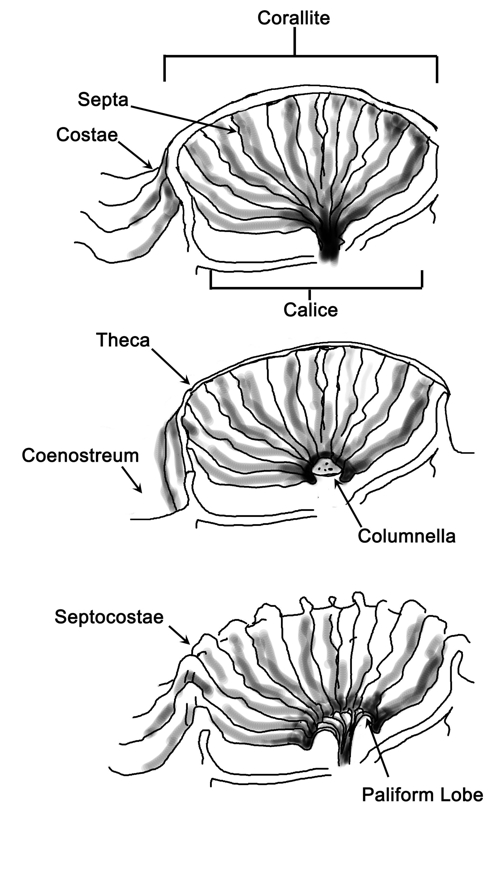
- Corallite - The skeletal cup that houses a single coral polyp. In colonial corals, many coralllites are connected together to form colonies. In solitary corals, the entire skeleton may be one corallite.
- Calice - The recessed area of the corallite where the polyp resides, may be deep or shallow, circular, oval, polygonal, or elongated, and may be isolated or connected into valleys such as in meandroid corals.
- Septa - Vertical radial plates inside the corallite that extend from the wall toward the center providing skeletal support. Septa are often toothed or serrated, and vary in thickness, hight, and spacing.
- Costae - Septa that extend beyond the corallite wall onto the colony surface, often radiating across the skeleton or connecting neighboring coralites. If the septa and costae are continuous they are referred to as septocostae or septa-costae.
- Corallite Wall/Theca - The outer boundary of a corallite, walls may be separate (plocoid, phaceloid), or shared between corallites (cerioid, meandroid).
- Coenosteum - The skeletal material between corallites in colonial corals. The coenosteum may be smooth, granular, spinose, ridged.
- Columella - A central skeletal structure that is formed by the fusion or twisting of septa at the corallite center. The columella may be spongy, styliform (rod-like), weak or absent.
- Paliform Lobe - In some corals the septa may dip down inside the center and rise up again to form a short vertical skeletal projection at the columella. When viewed from the top this can appear like a tiny corallite within a corallite.
- Monticules - In some corals there may be raised skeletal surface features formed by grouped septa or costae, such as the hard sketelal bumps found in Hydnophora.
- Verrucae - Raised wart-like skeletal protrusions formed by clusters of raidal corallites and coenosteum, often seen in branching corals like Pocillopora.
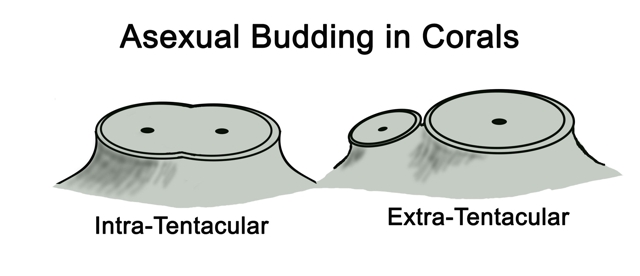
- Intra-Tentacular Budding - A mode of asexual reproduction in hard corals in which new polyps form by division within the exsisting tentactular ring of a polyp.
- Extra-Tentacular Budding - A mode of asexual reproduction in hard corals in which a new polyp forms outside the tentacular ring of a polyp.
© Conservation Diver, from Ecological Monitoring Program for Indo-Pacific Region (2019). Used with permission.